
I know that when I talk about lapbooks, I usually talk about using them with younger kids. But the truth is, they can be used with any age level. In fact, my students this year have been working on their own lapbooks, and it’s been so fun to see how creative they are with their topics.
So today, I want to share some ideas for using a four-door foldable in a math lapbook. If you don’t know what a four-door foldable is, you can find an example in Sarah Carter’s Four-Door Foldable Template post.
Choosing a Foldable Size for Your Lapbook
But first, let me explain why I’m even considering using a foldable like this in a lapbook. I’ve always considered foldables as something that would go into a composition notebook. And I think they’re great for that! But sometimes, when you’re making a lapbook, you need more writing room than just a composition notebook will allow.
So if you’re looking for a way to adapt your foldables to fit in your lapbook, you’ll probably want to compare the smaller template (which is sized for a composition notebook) with the full-sheet format. You can choose which one you’d rather use based on the available panel space and the content you plan to include in your lapbook. Neither format is guaranteed to fit your lapbook panel, but you can decide which option gives you more writing room for your intended content.
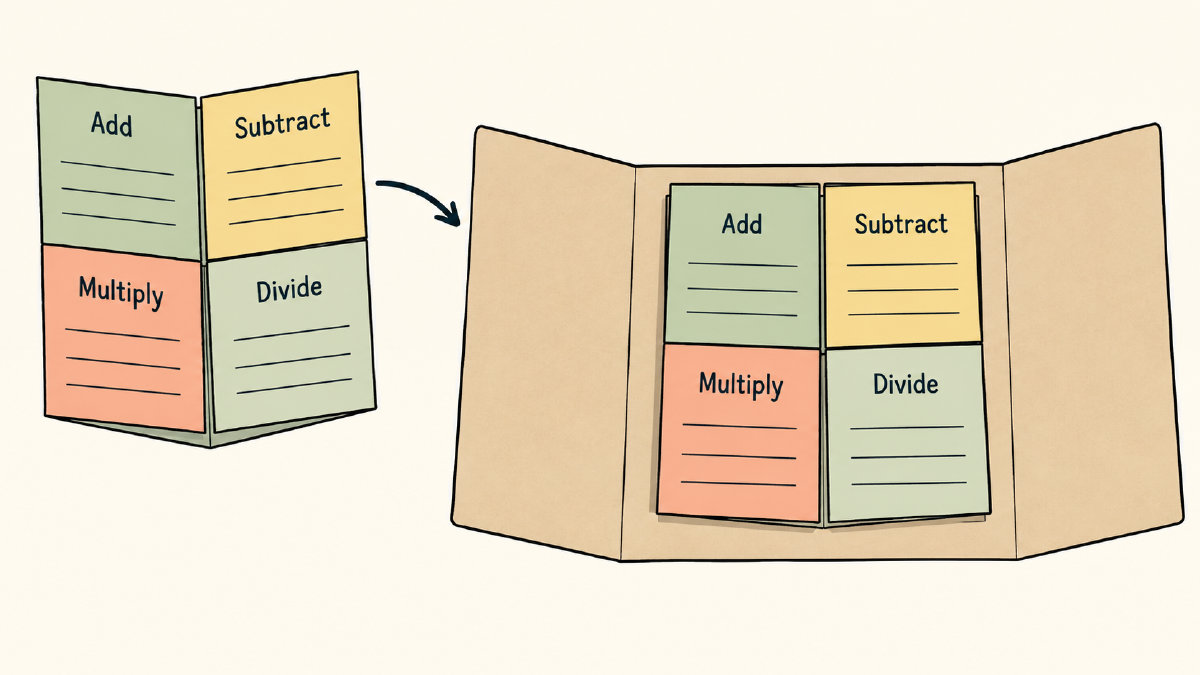
For instance, here’s Sarah Carter’s foldable for translating expressions.
This was actually created by Sarah Carter, and she originally made it with a full-sized sheet, then downsized it to fit into a composition notebook. She has several different versions of her foldable. One of those versions is the entire sheet, so you could print that and glue it directly into your lapbook without having to cut anything out. The other version is the smaller size, and then you’d have to cut out the doors to make the foldable.
Here’s the original post where Sarah shared her four-door foldable: Translating Expressions Foldable.
Translating Expressions Foldable (Entire Sheet)
In addition to being able to use either the smaller or full-sheet version, there are also color options. You can see her colorful sample in her Translating Expressions Foldable post.
Four-Door Foldable – Translating Expressions with Color
Sarah also had another version with color that only colored in the keywords that needed to be matched to the corresponding operation.
Four-Door Foldable – Translating Expressions with Keywords Colored
If you’re using this foldable in a lapbook, I’d suggest sticking with the four-operation plan. Just make sure that you have each operation represented on its own door. That means that each door should represent one operation: add, subtract, multiply, divide.
You can also choose to match the English words to the mathematical operations. For instance, you might circle “add” and box “subtract,” and then write “add” on the Math side of the table in green and “subtract” on the Math side of the table in red.
Another idea is to use a separate color for each operation. So “add” might be blue, “subtract” might be red, “multiply” might be yellow, and “divide” might be green. Then, you can highlight the English words in the matching colors.
Now, here’s another option. This one isn’t quite the same as the previous ones, but it’s still a four-door foldable. It’s one that Sarah Carter made for her Algebra 1 students while they were studying relations.
Four-Door Foldable – Relations
This particular foldable showed four different representations of the same relation. My students would encounter these representations on their end-of-year exam, so I wanted them to be familiar with all four.
Ordered pairs,
Input/output tables,
Coordinate planes, and
Mapping diagrams.
Of course, I didn’t do all four representations on one page. Rather, I did each one on a separate door. So instead of representing the four different operations, each door represented one of the four different representations.
Here’s the original post where Sarah shared this foldable: Ways to Represent a Relation Foldable.
If you’re going to use this foldable in a lapbook, I’d suggest doing the same thing. Pick one representation per door, and make sure that all of the examples you put in your foldable show one relation.
Comparing the Relations Foldable Versions
I chose this particular foldable because it was the simplest version of the foldable. I had done two other versions, and they were both more complicated. Sarah shares her 2014-2015 revision in the same Relations Foldable post.
Sarah’s earlier version is also in her Relations Foldable post.
The difference between the two versions is that the 2014-2015 revision included every example showing the same relation, whereas the version from last year had four different relations.
I’m not sure which version I’d prefer to use in a lapbook. Both have their pros and cons. The 2014-2015 version is much simpler, and it shows how all four representations can be used to represent the same relation. But the version from last year is more colorful, and includes more details.
Either one would work well in a lapbook, and it’s really up to you to decide which one you’d rather use.