
I love lapbooks. They’re such an easy way to make learning hands-on and interactive for your kids. And if you don’t have time to create something brand new, you can use one of my existing lapbook templates and just adapt it to the book you’re studying.
Today I’m sharing how to make a lapbook for Jerry Spinelli’s Maniac Magee. It’s a great book report project because there are so many themes that can be explored in this story, including prejudice, friendship, homelessness, grief, and family difficulties.
And since I know that some of you might want to make this into a lapbook for your own students (or even your children), here are the directions.
Print and Assemble the Lapbook
First, print out and cut out all of the pieces. You’ll need to organize them before cutting. The flap with the heading “The Search for Home” is the central plot accordion, and the rest of the flaps go around it. The flap with the heading “Two Mills” is the setting flap. The flap with the heading “Theme Evidence Cards” is where the theme cards will go. And the flap with the heading “Legend Versus Realism” is optional, but I included it just in case you wanted to do that as well.
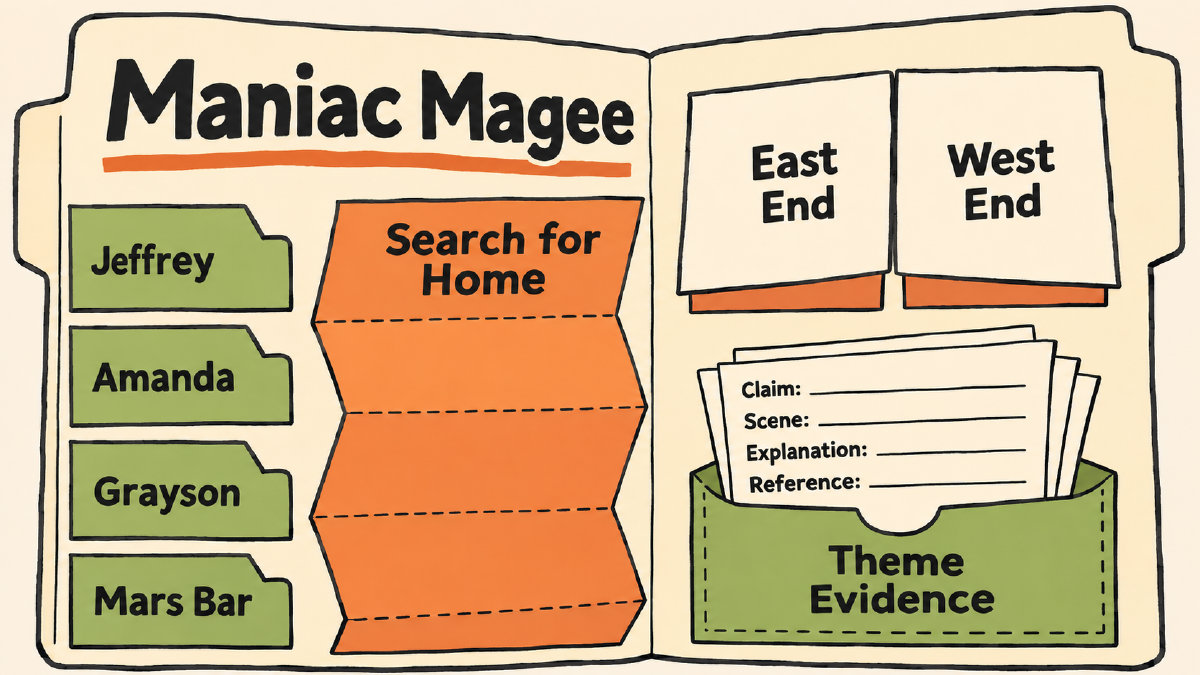
Then place the pieces loosely together in the order you want them on your lapbook folder. Check to see that each piece opens properly, and that the folder closes properly. Once everything looks good, attach the pieces to the folder.
So now that we’ve got the structure of the lapbook set up, let’s get into the details of what should go on each flap.
The Search for Home
Start with the central plot accordion. This is the main turning point of the story. Each short event summary should be paired with its effect on Jeffrey’s sense of home. Since the novel moves along in three parts, I recommend organizing the events in that order. Here are the events:
-
Departure from his guardians
-
Welcome with the Beales
-
Departure after trouble reaches the Beale household
-
Companionship with Grayson, a zoo worker
-
Grayson’s death
-
Jeffrey alone at the funeral
-
Wandering and a stay with the McNabs, a racist White West End household
-
Mars Bar recruits Amanda to seek Jeffrey at the zoo
-
Amanda calls Jeffrey home
-
Return to the Beales
You can find these events throughout the book, with Grayson’s death in chapters 30–32 and Amanda’s final invitation home in chapters 43–46.
Character Tabs
Next, the character tabs. Each character tab should include an action, an inference about the relationship, and supporting text. For example, for Jeffrey and Amanda, the action would be Amanda welcoming him and insisting that he come back home. The inference would be that Amanda cares about him. The supporting text could be any number of things — maybe her actions toward the Pickwells when she was growing up, or her actions toward the McNab boys at the zoo.
For Jeffrey and Grayson, the action would be Jeffrey teaching Grayson to read. The inference would be that Grayson gives Jeffrey a sense of belonging. The supporting text could be their conversations about books, or the fact that Grayson takes him to the zoo.
For Jeffrey and Mars Bar, the action would be Mars Bar rescuing Russell, the younger McNab brother, from the trolley tracks. The inference would be that Mars Bar takes both boys home. The supporting text could be anything from the way Mars Bar talks about the Pickwells, to his willingness to take both boys home despite their differences.
For Jeffrey and the Beales, the action would be the Beales accepting and loving him. The inference would be that he has found a place where he belongs. The supporting text could be the way they talk to him, or the way they act around him.
Two Mills Setting Flap
Next, the setting flap. This should include a comparison between two places in Two Mills. One side should focus on the Black East End and the other side should focus on the White West End. The comparison should connect households, encounters, and crossings to passages readers can locate. On the fictional Two Mills side, compare the Beale household with the McNab household. Within the West End, compare the McNab household with the welcoming Pickwells, who are always willing to set another plate for someone in need. You can find these comparisons on pages 18-19, 27-28, 35, 42, and 49-50 of the reader’s edition I used.
Lastly, the theme evidence cards. These should include a claim, a scene or short quotation, an explanation, and a chapter or page reference. The claims could be:
Belonging through the Beales and Grayson
Prejudice through hostile actions and changing friendships
Shared needs and capacities for love, acceptance, and home across racial differences
Hope for individual changes of heart and mind
Unresolved racism in Two Mills
Each card should examine what each scene demonstrates and leaves unresolved. For example, the scene where Jeffrey visits the Beales shows that he belongs with them, but also leaves unresolved the question of whether he will ever belong anywhere else. The scene where Mars Bar rescues Russell from the trolley tracks shows that people can change their minds and hearts, but also leaves unresolved the issue of whether racism in Two Mills will ever end.
Legend Versus Realism
If you’d like, you can also add an optional flap comparing an extraordinary feat that creates a legendary effect with the realistic difficulties. For example, Jeffrey’s nearly magical athletic prowess creates a legendary effect, but also leaves unresolved the question of whether he can survive without a home. Or, perhaps you’d prefer to use a different extraordinary feat from the novel, such as his ability to run faster than anyone else, which leads to his being called “Maniac.”