
This is the first time I’ve ever created a fiction lapbook organizer. It’s an original, untested idea, but I think this book report template for 5th graders might be a good fit for some students.
Adapt the Template to Your Assignment
I’ve included editable prompts in this template so that you can adapt it to your assignment before choosing mini-books. The basic story fields (title, author, main characters, setting, etc.) are pretty much unchanged from my previous book report templates. However, there are some differences with how I worded the prompts and arranged the layout.
Also, while I have included optional panels in the template, I would remove them if they don’t fit your assignment. For example, I wouldn’t include “rising action” or “falling action” panels if your assignment doesn’t require those things.
Drafting and Revising the Report
The two copy rough-draft practice is something I learned about from The Homeschool Daily’s author. She prints two copies of the worksheet her student chooses, using the first for a rough draft that they review together for grammar, sentence structure, and clarity. After revising, her student writes the final report on the second copy. Her students usually start doing rough drafts in fifth grade, and definitely by sixth grade.
So here’s how I’d walk through discussing, drafting, checking, and transferring the writing:
-
Discuss characters, plot, setting, and story dynamics.
-
Use the organizer as a separate copy of the report. Draft responses.
-
Transfer the draft responses into the lapbook mini-books before attaching everything together.
Basic Story Fields and Prompts
And here’s what I’d use as the basic story fields and beginning-middle-end prompts:
Book Title: ____________
Author: ____________
Main Characters: ____________
Setting — where and when: ____________
Beginning — How does the story start?
Middle — What happens as the story develops?
End — How does the story finish?
Optional Plot Stage Prompts
Here’s where I’d add plot-stage prompts, but only if the assignment requests it. If not, just leave them out.
Rising Action — Events building toward the climax:
Climax — The story’s turning point:
Falling Action — What happens after the climax:
I’m still working on the rest of the lapbook, but I thought I’d share the first part of it with you. If you like it, I’ll continue working on the rest. And if you hate it, I’ll try something else.
Arrange the Lapbook Mini Books
In the meantime, here’s a suggested arrangement of the mini-books:
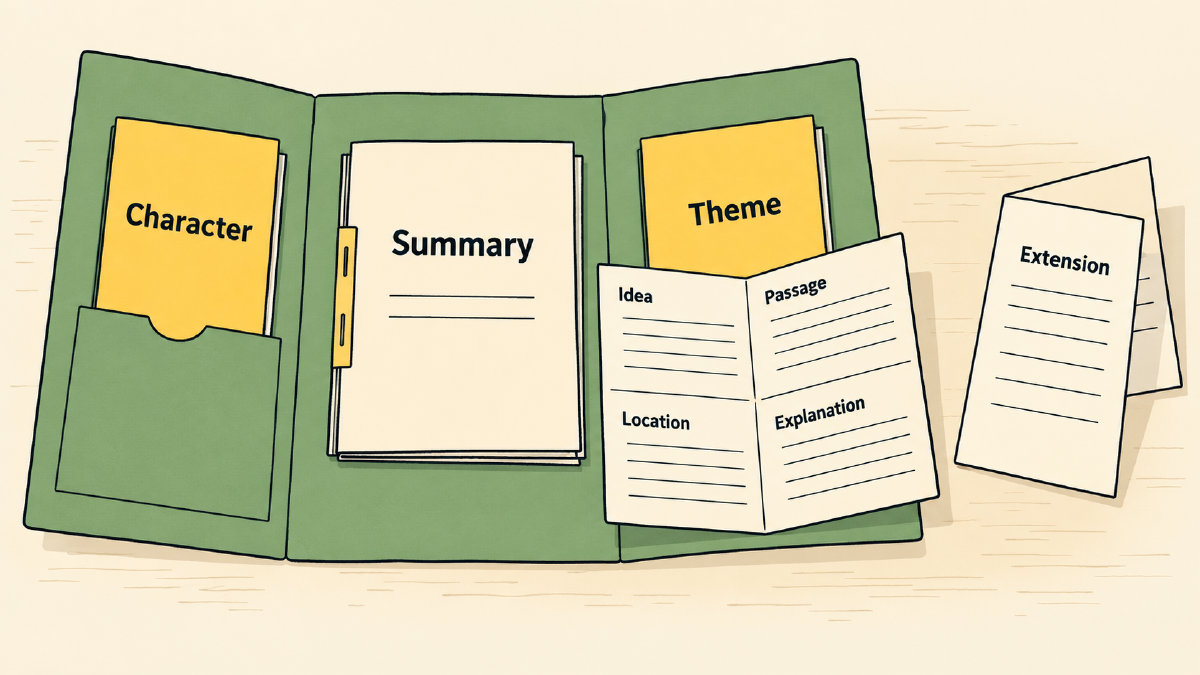
On the center, I’d put a summary booklet with spaces for writing about the beginning, middle, and end of the story.
On one side, I’d put a character booklet. On the other side, I’d put a theme booklet. Each analytical booklet would have its own interpretation on the opening panel, and then the inside spread would have the passage (quotation or paraphrase), page or chapter location, and explanation.
Character — What do you think this character is like? ____________
Supporting quotation or paraphrase: ____________
Page or chapter: ____________
How does this passage support your idea? ____________
Theme — What do you think the story says about life? ____________
Supporting quotation or paraphrase: ____________
Page or chapter: ____________
How does this passage support your idea? ____________
If needed, I could also add an extra folded sheet for more room, and I could make sure that each analysis has enough space for both the passage and the explanation.
Check the Writing Before Attaching
I’d check all of the writing before attaching anything together, making sure that the passages were accurate quotations or paraphrases, and that they were connected properly to the interpretations. Then I’d revise the writing, and transfer the revised writing into the mini-books before attaching everything together.
I’m not sure yet how this will actually fit, but I’ll keep working on it. I’ll post updates as I get closer to finishing the whole thing.