
I love interactive journals! They’re the perfect way to personalize learning, and they make it easy for students to record information and actively work with it. I know some people call them “interactive notebooks,” but that’s just overlapping educational terminology.
What Are Interactive Journals
An interactive journal is basically a paper-based place where you can record information in your own words (or drawings), and then work with that information through writing, images, and other activities. It doesn’t have to be anything fancy or pretty. You don’t even have to cut and glue things in it. In fact, you might not want to do any of those things if you’re looking for something more traditional.
You can use any kind of notebook for an interactive journal, whether it’s a spiral-bound notebook, or one that you’ve glued or taped together. You can also include handouts, articles, pictures, diagrams, etc., as long as you allow room for your personal responses on facing pages. But those responses don’t have to go on facing pages. That left/right arrangement is just one option.
Lapbook and Interactive Journal Organization
The difference between a lapbook and an interactive journal is simply about organization. A growing sequence of retrievable entries is best suited for a notebook. You’ll need numbered pages so that you can refer back to previous entries. You’ll need room to keep adding new entries, so a basic lapbook won’t work unless you’re willing to let go of the idea of having a folder full of everything related to an activity, and instead build a notebook with a growing table of contents.
But sometimes you can adapt a lapbook activity into a journal format by using a mini-book as your main entry. Here’s how I adapted this reading activity from The Classroom Nook into a journal format.
This is my proposed arrangement of the notes and response space for the foldable. You may prefer a different arrangement, depending on how you like to organize your notes. This is just my suggestion based on what I would do myself.
My first thought is that this is such a simple foldable, and it could easily be folded into a mini-book instead of being made into a lapbook. So here’s my idea…
I think it’s important to note that I’m not suggesting that we discard the lapbook idea. Sometimes a lapbook is a great way to arrange an activity within a folder project. But when there are no pop-up cutouts, coloring pages, or anything like that, I find that it’s easier to move a journal foldable into a lapbook while preserving the notes and response space. I think it’s much easier to check off each page of the reader’s own materials and see exactly where they want the information placed before attaching it to a folder. Plus, I think the actual placement of the notes and response space needs to be checked against the reader’s own materials anyway.
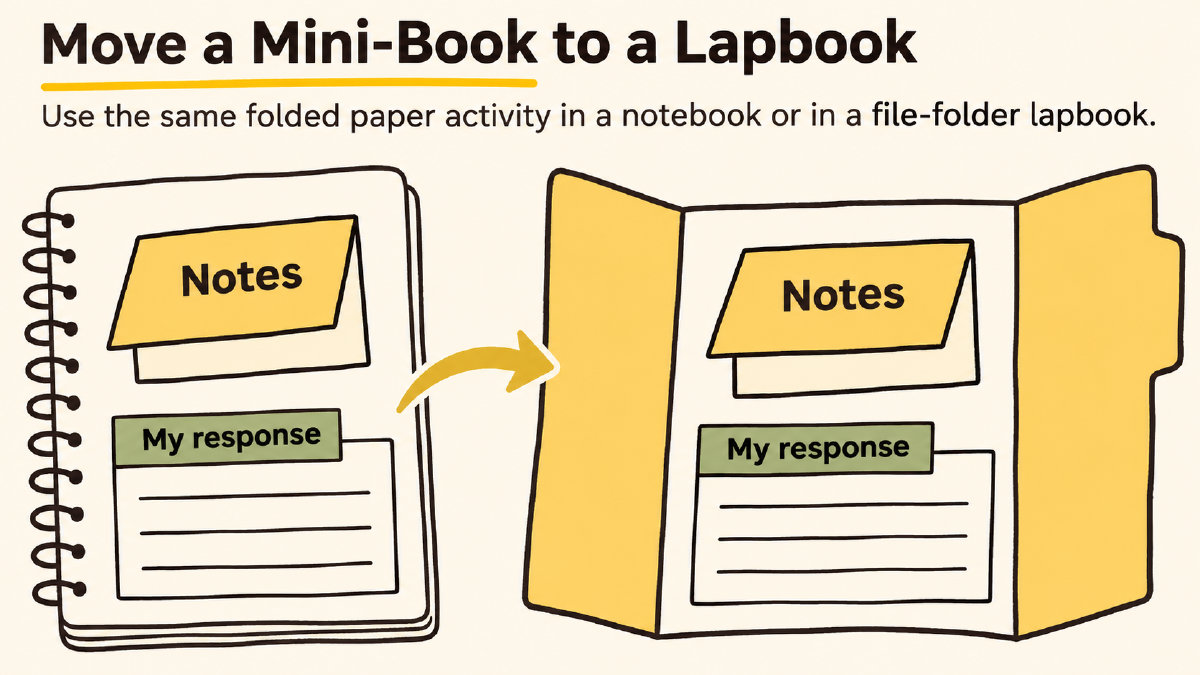
Arranging the Mini-Book and Response Space
So here’s my idea. I’d still make a simple folded mini-book. On the front cover, I’d put the question, “What changed in my thinking?” Then on the inside, I’d put their initial idea, and then a note from the text. Then on the adjacent response space, I’d write, “Now I think… because…” Before attaching anything, I’d arrange the closed mini-book and the response space beside it in the folder. Then I’d attach the back of the mini-book to the folder and check that the mini-book opens and the folder closes.
Then the mini-book would open, and the folder would close.
In this case, the learner would write her thoughts and ideas about the topic. She’d record information expressed in her own words or drawings. She might revisit her earlier notes and revise her thinking based upon what she learned from the text. She’d compare her initial idea with her later response, and support her response with a note from the text.
Of course, the exact details will vary depending on the activity and the grade level, but this is just a general idea of how an interactive journal works.