
I’ve had several requests lately for help with lapbooks. I’m not sure why, but I have been so busy lately that I haven’t gotten around to making any of my own. But the requests are coming in fast and furious, so I figured I should make a taxonomy foldable for you all right now!
Here’s how I’d do it…
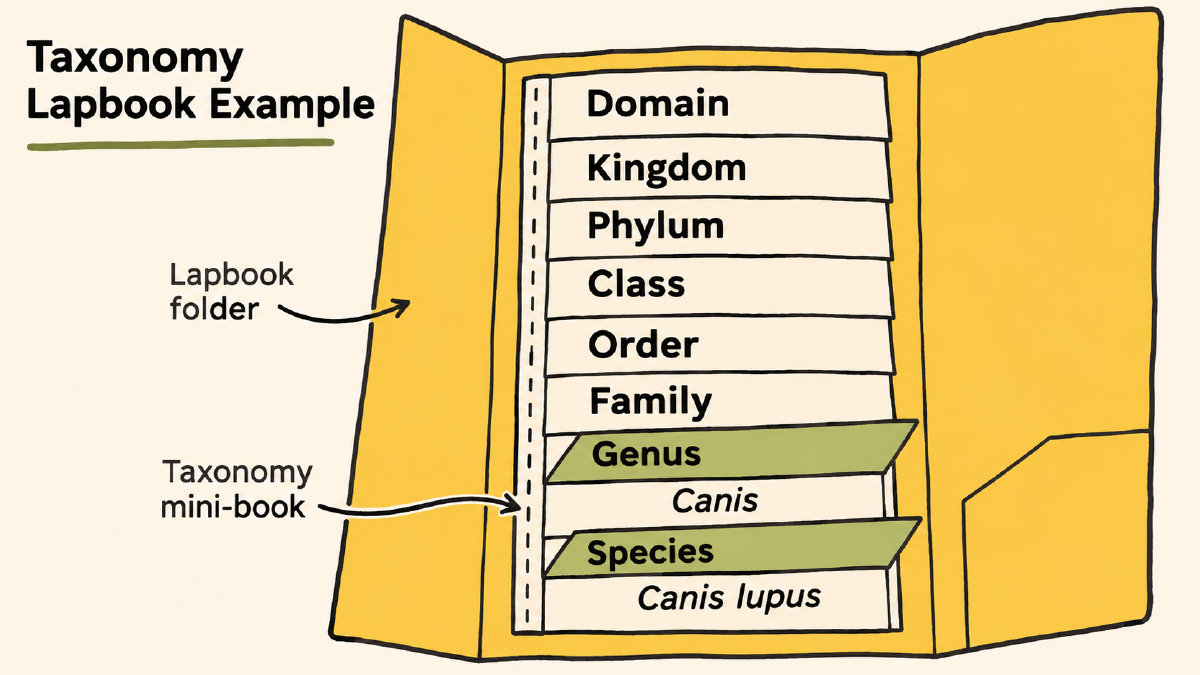
Write out the ranks
First, I would write out the ranks from broadest to most specific. For this assignment, I think you’ll want to use the full sequence (from domain down to species). If you don’t need to include domain, then start at kingdom.
Domain
Kingdom
Phylum
Class
Order
Family
Genus
Species
Each lower rank is nested within the rank above. So if you were using the gray wolf as your example, it would look like this:
Domain: Eukarya
Kingdom: Animalia
Phylum: Chordata
Class: Mammalia
Order: Carnivora
Family: Canidae
Genus: Canis
Species: Canis lupus
You can get the complete eight-rank gray wolf example here on RepeatLearn.
If you’re using the seven-rank system, then you can choose to start at kingdom. The difference between the two systems is that the seven-rank system does not include domain, which is a more recent addition to the taxonomy classification system. It’s still valid, though, so you may want to include it if your assignment requires it.
Cut and fold the taxonomy foldable
Once you’ve got the ranks written out, you can cut along the lines, stopping at the fold. This will give you eight horizontal bands of paper. Then you can fold them up, and write the rank names on the outside of each flap. On the inside of each flap, you’ll write the name of the group that fits that rank.
I would make this foldable about 8 by 10 inches. Then you can fold the 8-inch width in half, so that it closes into a book that is 4 by 10 inches. You can also find an alternate version of this foldable that is smaller, about 8 by 8.75 inches, with only seven flaps instead of eight. That’s just another option, though.
Fit and glue the pages
I wouldn’t glue these together until I was sure they fit perfectly into the folder. And I would definitely check to make sure that there was enough clearance to allow the flaps to open completely without getting caught on anything. I usually put mine together in front of me, and before gluing them together permanently, I move them around on the table to see how they fit into the folder.
When I’m satisfied with how they fit, I glue the back side of the pages together. That way, when the pages are folded and glued together, the information is on the front side, and the glue is on the back. This allows for the best results.
So once the pages are glued together, and the folds are done, I’ll place the closed book into the actual folder, and then tape the folder shut. When I’m ready to use the book, I’ll un-tape the folder, open it up, and flip it over so that the information is on the front side of the book.
References and species names
Of course, you’ll probably want to add some references. I used two different ones for mine. One is called RepeatLearn, and it has a complete eight-rank example of the gray wolf. The other is the ITIS Canis report. I used that one because it corroborates the kingdom through genus levels. However, it doesn’t list the domain level. Also, it lists the Canis lupus under the genus Canis as Gray Wolf. The problem with that is that the species entry is listed separately from the genus entry. So while the gray wolf is indeed a member of the genus Canis, it’s also its own species. So the listing on that database isn’t very helpful.
So I decided to use the RepeatLearn database because it includes the domain level, and also gives both the genus and species entries. Here’s how it looks in print: Canis lupus.
And in handwriting, I would write Canis lupus and underline each word separately.
Notice that the genus entry is capitalized, and the specific epithet is lowercase. Also notice that the specific epithet is italicized in print, and underlined in handwriting.
Also, notice that the species entry is actually two words. “Canis” is the genus entry, and “lupus” is the specific epithet. So when writing the species entry, you must write both words. If you only write “lupus,” then you’re only identifying the specific epithet, not the entire species.
In general, the genus entry is the same for every species in a particular genus. The specific epithet varies for each species.
So you can see that the classifications are subject to change with new information. There are times when we discover that an animal belongs to a different genus or family, etc., than previously thought. So even though the classifications seem pretty solid, they are never really set in stone.
Reference notes and rank labels
I would also add a small reference note beside the book: RepeatLearn, “Naming and Organizing Life: Taxonomic Ranks.” List whichever references you actually used, including ITIS if you used it, and the date you consulted them. When matching rank labels in ITIS, skip intermediate ranks like subkingdom and subphylum; don’t just copy consecutive lines.
It might be easier to understand the relationships if you could match the entries with their corresponding database entries by rank label. I didn’t copy the information from the databases directly, but rather copied the labels, and wrote the information underneath. That way, you can easily see that each entry matches up correctly by rank label. Of course, if you’re using a different database, you’ll need to check your information against that source to make sure that everything is correct. Just remember that you can always go back to your assignment or reference to double-check the information if you ever get confused about which labels to use.
Use the flaps for recall
So the next time you need to explain the classification of an organism, you can use the flaps to show the membership. Start with the broadest rank, and work your way down to the most specific. As you go, you’ll be showing the pattern of similarity, difference, and evolutionary relationship among organisms.
Don’t forget that classification is not based on developmental stages or advancement. An organism doesn’t progress from simple to advanced. Rather, it progresses from broad to specific. It doesn’t mean that an organism is more evolved simply because it’s placed further down the list.
So I suggest using this foldable as a recall activity. Have your child close the flaps, and try to recall the entries. Then he can reopen the book and check his answers.