This post is part of my series on how to make foldables for your lapbook.
The Triangle Sum Theorem
If you’re not familiar with the triangle sum theorem, it states that the sum of the measures of the interior angles of a triangle is 180 degrees. This means that if you have three interior angles of a triangle, their sum will always be 180 degrees.
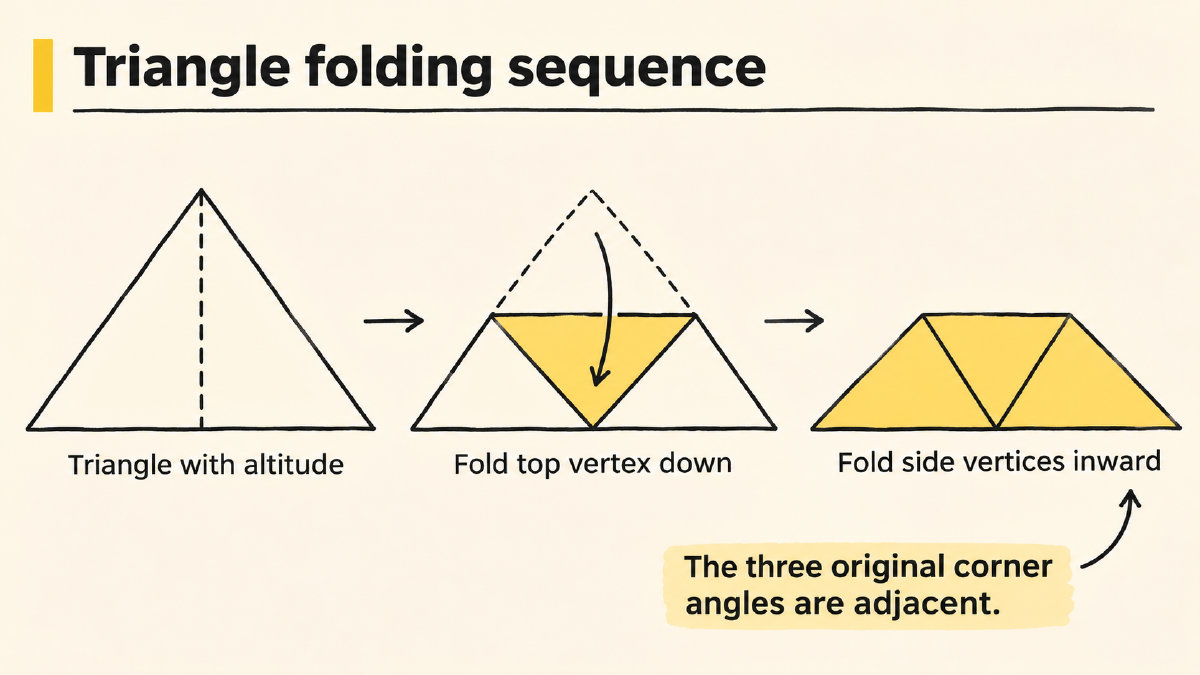
And just like we did with the angle addition postulate foldable, I wanted to create an illustration that would show why the triangle sum theorem works. And again, I found inspiration from my son’s geometry textbook, which shows a triangle folded along its altitude and then folded so that all three corners meet at the foot of the altitude. The result is a straight line (a straight angle) made up of the three original interior angles. It’s such a beautiful way to illustrate the theorem, but since I didn’t have any triangles cut out to demonstrate it, I decided to use a piece of paper to make my own demonstration.
Make the Triangle Sum Theorem Foldable
Here’s how to make the triangle sum theorem foldable:
Start by cutting out a triangle of any shape. I chose a right triangle because it was simple to fold.
Next, place the triangle with the longest side at the bottom as the base.
Now fold the base onto itself so that the crease passes through the opposite, topmost vertex.
Then crease through the opposite, topmost vertex to make a crease through the triangle.
Open the triangle back up.
Now take the topmost vertex and fold it down so that it meets the foot of the altitude.
This corner-fold crease is a midsegment of the triangle.
Now take each of the two base vertices and fold it to the same point where the topmost vertex was folded down.
Once all three vertices are folded down to the same point, they’ll all meet at the foot of the altitude.
How the Folded Angles Add Up
I labeled each of the original interior angles A, B, and C before folding. As you can see in the illustration above, after the folding sequence, the labels still remain, but they’ve moved around quite a bit. So when the corners are folded down, the labels are now in their new positions. If done correctly, the three corners should form a straight angle, and the three interior angles should add up to 180 degrees.
So while the triangle is still folded, the paper arrangement is an illustration of the triangle sum theorem. All three original interior angles are preserved in the folded corners, and the adjacent angles along a straight line represent the sum of the interior angles of the triangle. That straight line is called a straight angle, and it measures 180 degrees. Therefore, A + B + C = 180 degrees, and all triangles in plane geometry obey this rule.
Store the Triangle in Your Lapbook
You could also adapt this documented movable folding activity into a removable lapbook arrangement, storing the triangle in a pocket so that it can be removed, unfolded, and refolded over and over again. I’d suggest something like this…
With the triangle stored in the pocket, you can keep the explanation visible beside it.
A Worked Example
For an original worked example applying the triangle sum theorem, I’ll leave plenty of space beside the foldable for the calculation and for reminders to the learner that he/she must recognize interior angles, read degree notation, and add and subtract whole numbers. If two interior angles measure 50° and 60°, the third measures 180° − 50° − 60° = 70°. And we can check: 50° + 60° + 70° = 180°.
Of course, there are many variations of this foldable. But this version is very easy to make, and it clearly demonstrates the triangle sum theorem.